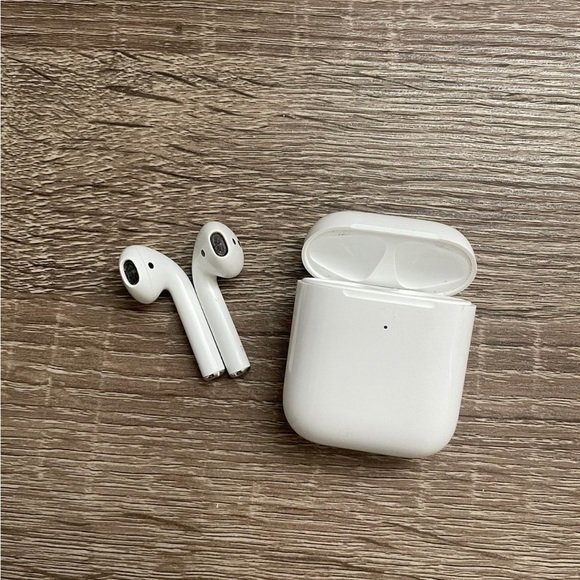
Imagine a world before truly wireless earbuds. A world of tangled cables, cumbersome Bluetooth pairing, and the constant fear of snagging a cord. Then, in 2016, Apple stepped onto the stage with a tiny, white, seemingly simple device that would change everything: the 1st Generation AirPods. Dismissed by some and mocked by others for their "toothbrush head" design, these unassuming earbuds quickly sparked a revolution, paving the way for the wireless audio landscape we know today.
More than just headphones, AirPods represented a paradigm shift in how we interact with technology. They were an extension of our digital lives, seamlessly integrating with the Apple ecosystem and offering an unprecedented level of convenience. From their instant pairing to their intuitive controls, the original AirPods laid the groundwork for a new era of personal audio.
The Genesis of Seamless Sound: Unpacking the Original AirPods
When the 1st Generation AirPods first arrived, they weren't just another pair of headphones; they were a statement. Apple's proprietary W1 chip was the silent star, enabling an almost magical pairing experience with iOS devices and optimizing Bluetooth 4.2 connectivity for reliable performance. This wasn't just about cutting the cord; it was about making wireless audio effortless.
The design was iconic, albeit initially controversial. Each AirPod was lightweight at just 0.14 oz, sitting comfortably in the ear while housing an accelerometer and optical sensors for intelligent features like automatic pausing when removed. The compact charging case, weighing 1.34 oz, provided not only protection but also a vital power boost, offering an additional 24 hours of listening time on top of the AirPods' 5-hour endurance. To dive deeper into what made these groundbreaking, you can Explore 1st Gen AirPods features and see the detailed specifications that kicked off this era.
From Skepticism to Status Symbol: A Cultural Phenomenon
Initially, the 1st Gen AirPods faced their share of critics. The design was unusual, the concept of "true wireless" was still novel, and the price point was certainly a topic of discussion. Yet, despite the early chatter, AirPods quickly transcended their technological origins to become a genuine cultural phenomenon. They weren't just an accessory; they became a ubiquitous symbol of convenience, modernity, and, for many, a discreet "do not disturb" signal in a busy world.
Their market performance speaks volumes: from an estimated 14-16 million units sold in 2017 to a staggering 60 million in 2019. The 1st Gen AirPods didn't just sell; they defined a category, inspiring countless imitators and establishing Apple as the dominant force in the rapidly expanding "hearables" market. They proved that sometimes, the simplest solutions can have the most profound impact.
Living with Your 1st Gen AirPods Today
Even years after their initial release and subsequent discontinuation in 2019, many users still rely on their 1st Generation AirPods. They continue to function as reliable Bluetooth headphones, offering that signature Apple experience. However, like any piece of technology, particularly battery-powered ones, they come with certain considerations as they age.
Maximizing Your Listening Time
One of the most common challenges for long-time 1st Gen AirPods owners is battery degradation. Those original 5 hours of listening time might now feel like a distant memory, with older sets often struggling to last half that. Each AirPod contained a 93 mWh battery, and the case a 1.52 Wh battery, designed for excellent performance initially, but finite in their lifespan. Understanding how to extend their usability and mitigate battery wear is key to keeping them functional. If you're looking to squeeze every last minute out of your beloved earbuds, you should certainly Optimize your 1st Gen AirPods with our dedicated guide.
Navigating Common Hurdles
Beyond battery life, early adopters of the 1st Gen AirPods might recall certain quirks, such as rapid charging case battery depletion, an issue Apple later addressed with firmware updates. While the core functionality remains robust, users might encounter connectivity glitches or other minor frustrations as the hardware ages. From ensuring full compatibility with older iOS/macOS versions to dealing with connection drops, knowing the typical pitfalls and their solutions can save you a lot of headache. For comprehensive solutions and tips to keep your earbuds running smoothly, we encourage you to Solve your 1st Gen AirPods problems.
The Enduring Question: Are They Still Relevant?
In a rapidly evolving market now populated by 2nd, 3rd, and even 4th generation AirPods, AirPods Pro models, and AirPods Max, the question of the 1st Generation's relevance is more pertinent than ever. While production ceased in 2019, many units are still out there, either in active use or available second-hand.
The Case for Keeping or Buying
For those who prioritize simplicity, a familiar fit, and the classic Apple experience without the need for advanced features like active noise cancellation or spatial audio, the 1st Gen AirPods can still offer value. They connect seamlessly, provide decent sound for casual listening, and their lightweight design remains a strong selling point for many. They function perfectly as standard Bluetooth headphones across various devices, including Android and Windows, albeit without the full suite of Apple-exclusive features. Considering their place in today's tech landscape, it's worth asking: Are 1st Gen AirPods worth it for you?
Comparing Generations: When to Upgrade
Apple's subsequent AirPods generations introduced significant enhancements: the H1 chip with "Hey Siri" and Bluetooth 5 in the 2nd Gen, the redesign, spatial audio, and MagSafe charging in the 3rd Gen, and major upgrades like ANC, Transparency Mode, and improved sound in the AirPods Pro lines. Each new release built upon the original foundation, pushing the boundaries of wireless audio. Understanding these advancements is crucial if you're weighing an upgrade. If you're wondering how your original AirPods stack up against their newer siblings, our detailed comparison can help you decide: 1st Gen AirPods vs. Later.
The 1st Generation AirPods weren't just a product; they were a harbinger of the wireless audio future. They democratized the true wireless experience, proving that a seamless, intuitive design could overcome initial skepticism and redefine a category. While newer models offer advanced features and improved performance, the original AirPods remain a testament to Apple's vision and an important chapter in the history of personal technology. They truly began Apple's wireless earbud revolution, a legacy that continues to evolve with every new release.